Showing posts with label book reviews. Show all posts

Sunday, May 6, 2012

What to Read After The Hunger Games


[*Beginning of THG spoilers]

So, you’ve read The Hunger Games trilogy. You’ve journeyed with Katniss through two arenas, several rebellions, and a war. You’ve seen the love triangle play out to the end, you’ve mourned the tragic deaths of some of your favorite characters, and now you can sleep knowing that there are survivors who are safe, if not entirely sound.

[*End of THG spoilers]

The big question is: What now?

What can possibly take the place of The Hunger Games trilogy on your bookshelf?

The answer is simple: Nothing.

There is no trilogy like The Hunger Games, and trying to find a replacement would be like Cinna deciding to stop being fabulous. It won’t happen.

But there is hope! I’ve had lots of questions from friends asking me what to read next, and I can tell you with great enthusiasm that The Hunger Games might be the lamb stew, but there are lots of other tasty meals on the menu.   

People like The Hunger Games for many different reasons, and I have categorized my suggestions based on several endearing qualities of the books. If I didn’t address why you liked the books, please leave me a comment and I’ll get you a recommendation.

So, if you liked The Hunger Games (THG), consider reading the following books. I’d love to know what you think once you’ve read them, and I hope you have recommendations to add!


Category: OMG Please Read This Book

Ender’s Game by Orson Scott Card

This book came out in 1985, but it is as relevant and poignant today as it was when it was winning awards almost 30 years ago.

I’ve read that this book is mandatory for training in the Marine Corps, and I can see why. In this book, the Capitol in THG is instead an international space fleet with a school that trains children to become soldiers who will defeat the “Buggers”, or aliens who are set to invade Earth. Ender Wiggin is taken from earth at a young age to attend the Battle School.  Through a series of training games, Ender shows his promise as a tactician in increasingly difficult scenarios. Through it all, Ender struggles with rage and violence, empathy, self-definition, and humanity.

This book blew my mind. If you see the ending coming, you are my hero because I was shocked, and I can usually predict these things.

Favorite quote: “There is no teacher but the enemy.”

The movie based on this book is in production now and will be released next November. I encourage you to #readitfirst !

Also, The Giver by Lois Lowry has a similar feel and is a very good book.


Category: Strong female lead, survival, figuring stuff out

The Girl with the Dragon Tattoo series by Stieg Larrson

There has been almost as much hype about this mystery thriller series and the movies as THG, and both the books and the films live up to their fame. The journey of Lizbeth and Mikael and the mysteries they solve lead to fist pumping, hair pulling, horror-stricken moments. Wading through the many names and thick detail can be tough, and the story is much darker than THG, but the plot and the characters are worth it. 


Other recommendations in this category:
The Scorpio Races by Maggie Steifvater
The Privilege of the Sword by Ellen Kushner
The Disreputable History of Frankie Landau-Banks by E. Lockhart
The Forest of Hands and Teeth by Carrie Ryan


Category: Political intrigue and regional struggles

The Game of Thrones series by George R.R. Martin

You may think they’re just crazy fantasy books that have evolved in to a wildly successful HBO series, but I’m telling you, these books are about people; good people and the very worst types of people, all of them flawed and endearing. The complicated stories are engaging, the writing is beautiful, the characters are lovable and contemptible, and the fantasy overlays political, social, and emotional realism. Like the Dragon Tattoo series, these books are heavier on details and names than THG, but they are just as enthralling.


Other recommendations in this category:
Leviathan series by Scott Westerfeld


Category: Young Adult Dystopia Series   

The Maze Runner series by James Dashner

This seems to be the go-to recommendation for what to read after THG. I liked the first book, but the series did not engage me as much as some other books on the list. Still, it’s worth noting that these books may be a good next read.

Other recommendations in this category:
Graceling, Fire, and Bitterblue by Kristin Cashore
The Uglies series by Scott Westerfeld
The Matched series by Allie Condie
Delirium and Pandemonium by Lauren Oliver  
Divergent and Insurgent by Veronica Roth
The Chaos Walking series by Patrick Ness


Category: Young Adult Fantasy

The Twilight series by Stephanie Meyer

What are you doing? Just read them already. You know you want to.


There are SO many more books I hope you read, but these made the short list for those of us missing The Hunger Games books. I can’t wait to hear your thoughts!

It makes my day when I hear from you on Facebook, Twitter, email, or in comments below.

Happy reading!

Sunday, January 8, 2012

My 2011 in Books


We’ve established that I am a prolific reader. This blog is mostly about the books I’ve read, so my plan was to write a year-end post about the very best books I experienced in 2011. In reviewing my on-line library, however, I realized that I wanted to comment on more than just the great books, I wanted to share my thoughts on the books that weren’t so great, too. 

I read 76 books in 2011. That’s not including the books I reread because I love them. I can’t go a year without reading The Hunger Games Trilogy, Pride and Prejudice, Emma, Sense and Sensibility, Wuthering Heights, Graceling and Fire, selected books from the Harry Potter series, and of course the Twilight Saga.

I know. That’s a lot of books. I am a sucker for a free or $99 Kindle ebook and I get sucked into series even if the books are not that great. I’ll be the first to admit my booklist in 2011 was not the most discerning, but there was some fiction that blew my mind, elevated my love of reading, and inspired me to continue to write.

Here is a simple synopsis of books that I loved, books that were okay, and books I wish I had never read.

Books that blew my mind:

Ender's Game by Orson Scott Card
The Night Circus by Erin Morgenstern
The Scorpio Races by Maggie Steifvater
The Daughter of Smoke and Bone by Laini Taylor
Chime by Franny Billingsley
Miss Peregrine's Home for Peculiar Children by Ransom Riggs
Delirium by Lauren Oliver
Beauty Queens by Libba Bray
The Truth About Forever by Sarah Dessen
Shine by Lauren Myracle
Divergent by Veronica Roth


Books I loved:

Leviathan, Behemoth, and Goliath by Scott Westerfeld
13 Little Blue Envelopes, The Last Little Blue Envelope and The Name of the Star by Maureen Johnson
Clockwork Prince by Cassandra Clare
Sweethearts by Sarah Zarr
Death Comes to Pemberly by P.D. James
Forever by Maggie Steifvater
The Grand Sophy by Georgette Heyer
The Winter Sea by Susan Kearsley


Books I liked a lot:

How to Be Bad by Lauren Myracle, Sarah Mlynowski, and E. Lockart
Austenland by Shannon Hale
Fingersmith by Sarah Waters
City of Bones, City of Ashes, and City of Glass by Cassandra Clare
A Discovery of Witches by Deborah Harkness
Queen of Babble by Meg Cabot
The Adventures of Sherlock Holmes by Sir Arthur Conan Doyle
The Privilege of the Sword by Ellen Kushner
Water for Elephants by Sara Gruen
The False Princess by Eilis O'Neal
The House at Riverton and The Distant Hours by Kate Morton
The Girl of Fire and Thorns by Rae Carson
Between the Lines, Where You Are, and Good For You by Tammara Webber
A Great and Terrible Beauty, The Sweet Far Thing, and Rebel Angels by Libba Bray


Books that were okay:

Not That Kind of Girl by Siobhan Vivian
Flat-Out Love by Jessica Park
Silence by Becca Fitzpatrick
The Girl in the Gatehouse by Julie Klassen
The Girl Who Was On Fire by various authors
Evermore by Alyson Noel
Pride and Prejudice and Zombies by Jane Austen and Seth Grahame-Smith
The Chosen Soul and The Game by Heather Kilough-Walden
Ashes by Ilsa Bick
Eternal Eden by Nicole Williams
So Over You by Gwen Hayes
Breathless by Heather C. Hudak
The Trouble with Kings and A Posse of Princesses by Sherwood Smith
Lover Unleashed by J.R. Ward
Camille by Tess Oliver
The Hangman's Daughter by Oliver Potzsch
Incarceron by Katherine Fisher


Books that I wish I hadn’t read:

Beautiful Disaster by Jamie McGuire
Immortal by Lauren Burd
Sam I Am by Heather Killough-Walden
The entire House of Night Series by P.C. Cast and Kristen Cast
Passion by Lauren Kate
The Wicked Woods by Kailin Gow


So there you have it. My 2011 reading list. There are several books I’m excited to read in 2012. I’ll do a post on that soon.

Until then, happy reading!


Tuesday, September 6, 2011

Pacing, Structure, and Anger

I’m mad at a book, but I’m not going to tell you which one*.
The book I just finished had so much buzz about it that I read the first part of it online, desperate to get a glimpse of the novel that, “is the new book for the Hunger Games crowd.” Then I preordered it, hoping it would deliver to my Kindle early so I would be able to read it before today’s release date. The book downloaded yesterday. I stayed up most of the night finishing it.
So, if I read most of the book without putting it down it must be good, right? Right? 
Wrong. Not completely wrong, but big lots wrong. And the ending?!?! So. So wrong.
The main problem was the pacing. The book is the first in a trilogy, but it read like the first third of one book, not the first installment of three stories.
Look, I love book series. I get that not all stories can be told in one go, that you need more than one book to resolve the overall conflict and fully discover the world the author creates. But each book in a series needs to have all components of story structure.
We all know the basics of story structure, right? It was drilled in to us in high school. You’ve probably seen this graph, but I like the one further down better.

You start with exposition, which sets the tone and scene and introduces the main characters.
Then on to rising action. The initial conflict occurs, the main character now has a story goal, and more characters enter the story. Either the main character is working with these other characters or against them (antagonist) to complete their story goal.
And then …


There. That big black vertical line. You see it? Tension. Right smack in the middle of the story (or at 50% on Kindle). Let’s remember that we can have conflict throughout the story, but the reader needs more than that. A major revelation, a game changer that raises the stakes. It’s a figurative car crash scene after which everything changes. Characters see each other more clearly or they learn something significant about whoever is oppressing them. Then, after this event, a plan begins to form based on our new knowledge. We now know our enemy better, and our goal becomes clearer. There is something to work for, and a plan begins to form.
Continuing in the rising action portion of our story, our main character plots and plans. She struggles against adversaries, but has alliances, too, who help her with her story goal.
Then, finally, at about 85%-89%, it is time to execute the plan. This is the climax. We are riveted as our main character takes the risk. She utilizes the strengths she has gained throughout the book, overcomes challenges, she may realize something she hadn’t thought of before, but the plot points were leading her here all along. She triumphs.
Then, right at about 95%, we get our falling action and our resolution. The story goal is met, the future is described or alluded to, the lessons learned are delineated. In a series, there would also be a set up of the next part of the story with some kind of antagonism.
I checked. All of my favorite books have these elements, including the tension right at the half way mark. In Twilight, 50% is The Meadow scene. In Pride and Prejudice, Mr. Darcy proposes to Elizabeth exactly half way in to the story. In The Hunger Games, Katniss fights off the Career Tributes for the first time.
In the book I just read, the halfway mark simply represents the end of one type of challenge and the start of a new, more mysterious challenge for our main character. We are taken from two of the characters we were invested in and then introduced to new characters. Our main character does not have a clear story goal, a coherent plan, or even an idea of who the enemy is. There are no important revelations, in fact, we are given very little information, and our heroine has lost her motivation. Don’t get me wrong, there’s action, a lot of it. It’s intense at points, especially in the beginning. This is what kept me reading. But without a stronger structure to the story there is no climax, and one challenge simply blends to the next.
And the ending! OMG the ending was infuriating. Near the end of the book, I’m talking at 93%, the main character finally gets a clue as to what is really going on. She decides to leave the crazy place she is in (this is where we should have been at the 50% point). Then, at 99%, she finally does leave, but discovers that the world she was in was even crazier than she could imagine. That’s it. No real answers. No resolution. Just part of an unfinished story.
Now, I like a good cliff-hanger, but you have to have a story to back it up. There has to be tension, clear consequences, a known opponent.
Here’s how the story should have gone. Keep in mind this is a contemporary young adult fantasy/apocalypse story.
0-10% - Main character “A” intro, disaster happens
10-20% - Struggles/conflict (lose supplies, strange creatures attack, etc.), intro little girl character “B” who relies on main character, something strange is happening, no real info, scary times, need help
20-30% - Intro love interest character “C”, seek shelter, get info on what is happening, ABC characters grow closer, go through challenges together
30-40% - ABC decide to leave current shelter to learn more about what is going on in real world, little girl B is taken, then love interest C gets hurt
40-50% - Main character A goes to find help, love interest B disappears, main character A enters strange town. A’s story goal: get ABC back together.
50-85% - Main character A realizes strangeness of town/danger right away, learns concrete information, creates a clear plan to escape, grows connected with some people in the strange town, even has a new love interest “D,” but feels ever stronger about her purpose and finding B and C.
85-95% - Executes plan, lots of tension and challenges in escaping, internal conflict b/c of those she’s leaving behind. Learns the strange town is even crazier than she thought, fuels her to keep going but makes her even more scared. Working for her story goal – to get back to B and C.
95% - Finally she reaches B and C. She rescues B (or they rescue each other?), then she finds C in a new town. So grateful to be back together. She describes the strange town to the new town, learns quickly how things operate in the new town, which is better because it’s a military structure and B is a leader. She expects the strange town people to come for her.
98% - Set up for next book. The strange town invades the new place. The new place is outnumbered, but led by military strategy and home field advantage give them the upper hand. Main character A is fighting and breaks her opponent’s arm. It’s her love interest D from strange town. Shock. Then she has a gun pointed at her and it goes off.
End.
I know you didn’t read the book I’m talking about, but trust me, this would have been better. The author still could have maintained the characters, writing style, nuances, etc. that make the story good, but we would have had a complete book with anticipation for the next one in the series.
If they’re touting this as the next book for Hunger Games readers, it falls shy of the mark. Each of the HG books had a self-encased, fully fleshed story. Yes, each book included a set up for the next book and a cliff-hanger, but that was after the story was resolved.
There were other things that bugged me about the book, and lots of things I liked. I won’t detail them here. From the reviews I’ve read, everyone else loved this book, so maybe I expect too much.
I don’t have an MFA in creative writing and I’ve published exactly zero novels, but I read a lot. I can tell what works. And I’m telling you, readers should expect more than this.


*I chose not to name this book because writing is hard and I'm not a book critic, although a tiny bit of Googling will lead you to it.

Sunday, September 4, 2011

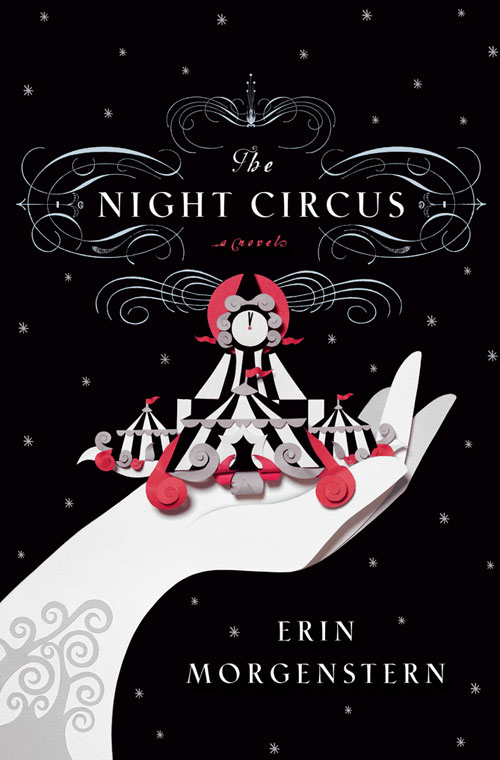
The Night Circus by Erin Morgenstern


“I find I think of myself not as a writer so much as someone who provides a gateway, a tangential route for readers to reach the circus. To visit the circus again, if only in their minds, when they are unable to attend it physically. I relay it through printed worlds on crumpled newsprint, words that they can read again and again, returning to the circus whenever they wish, regardless of time of day or physical location. Transporting them at will.
When put that way, it sounds rather like magic, doesn’t it?”
-          From The Night Circus

The author Erin Morgenstern is a magician. Not the pulls-rabbits-out-of-hats- pick-a-card kind of magician, but a transcendent storyteller whose magic is captured on the pages of her new book, The Night Circus. From the first pages the reader is so immersed that she is surprised to look up and see the living room rather than the mysterious and enchanting world Morgenstern creates on the page. The reader pauses, unsure it’s healthy to be that completely immersed, then goes back to the book, expecting the pages to transform somehow. Convinced that there is a secret gateway to the tents, that when the sun sets she will be able to enter the world for real.
I was able to get my hands on an Advanced Readers Copy (ARC) of this book through Twilightish.com before it comes out this Tuesday. There’s a lot of buzz about this book, so I was thrilled to have the opportunity to read it before it hits the shelves officially.* Here’s a brief description of the book from Morgenstern’s website:
“The circus arrives without warning. No announcements precede it. It is simply there, when yesterday it was not. Within the black-and-white striped canvas tents is an utterly unique experience full of breathtaking amazements. It is called Le Cirque des RĂªves, and it is only open at night.
But behind the scenes, a fierce competition is underway—a duel between two young magicians, Celia and Marco, who have been trained since childhood expressly for this purpose by their mercurial instructors. Unbeknownst to them, this is a game in which only one can be left standing, and the circus is but the stage for a remarkable battle of imagination and will. Despite themselves, however, Celia and Marco tumble headfirst into love—a deep, magical love that makes the lights flicker and the room grow warm whenever they so much as brush hands.
True love or not, the game must play out, and the fates of everyone involved, from the cast of extraordinary circus per­formers to the patrons, hang in the balance, suspended as precariously as the daring acrobats overhead.”


The brilliance of this book is not only in its characters and plot; it is also in the way the story is told. It is in the pacing and the manipulation of the reader throughout the book.
We experience the mystery of the circus as we learn its secrets, its history. The author addresses the reader directly in the opening scene, guiding us to experience firsthand the mysterious night circus appearing without announcement. Then we are transported back in time more than a hundred years, where we are introduced to several main characters and the competition. Now we are in the present again with our ticket in hand. We’re ready to enter the gates, and suddenly we are transported several decades after the competition begins where we meet a boy going to the circus for the first time. Now we are in the circus courtyard. We see the white flames of the bonfire that plays a central role in the magic. Then we are back at the “start” of the story again. We learn about the inception of the night circus and we meet more mysterious and talented characters. Our personal encounters at the circus mirror what we learn about the circus throughout the story.
Time is treated differently in The Night Circus. It is like the caramel on the apples that scent the courtyard, pulled and stretched and manipulated to fit its purpose. The central art piece is a unique clock that stands sentry at the entrance. Characters age differently and feel the futility of attempting to control time. The fortune teller says, “The most difficult thing to read is time, maybe because it changes so many things.” It is fitting that the story is not told in a linear timeline. The relevant pieces fit together, creating a puzzle and then a picture and then a piece of art.  
This captivating world gains flesh and texture though the themes weaved within the story. Throughout this journey we become part of a world where creativity is valued, embraced, and built upon. An unusual midnight dinner becomes a tradition, costumes and setting play a critical role for the patrons of the circus and also for the reader, and magic becomes collaboration, which then becomes the magic.
Cages are an interesting theme throughout the book. Whether one is caged by circumstances or choices or devotion, and what can be termed imprisonment to one can be deemed freedom to another.
Color is significant. The entire circus, from the flames of the fire to the dusted or painted ground, from the tents to the costumes to the art, everything is either black or white or gray. This non-chromatic work belies the complexity of the circus. The world we enter is neither black nor white, or shades of gray, it is whatever our imagination chooses. In the closing sections of the book, the author is seemingly talking directly to the reader as one character states, “Someone needs to tell those tales … there’s magic in that. It’s in the listener, and for each and every ear it will be different, and it will affect them in ways they can never predict. From the mundane to the profound. You may tell a tale that takes up residence in someone’s soul, becomes their blood and self and purpose. That tale will move them and drive them and who knows what they might do because of it, because of your words. That is your role, your gift … There are many kinds of magic, after all.”
I hope you read this book, if only to discover what form the magic takes in you.

*Note: I was not compensated in any way for this review. I just want you to read the book. It’s good. Really.